

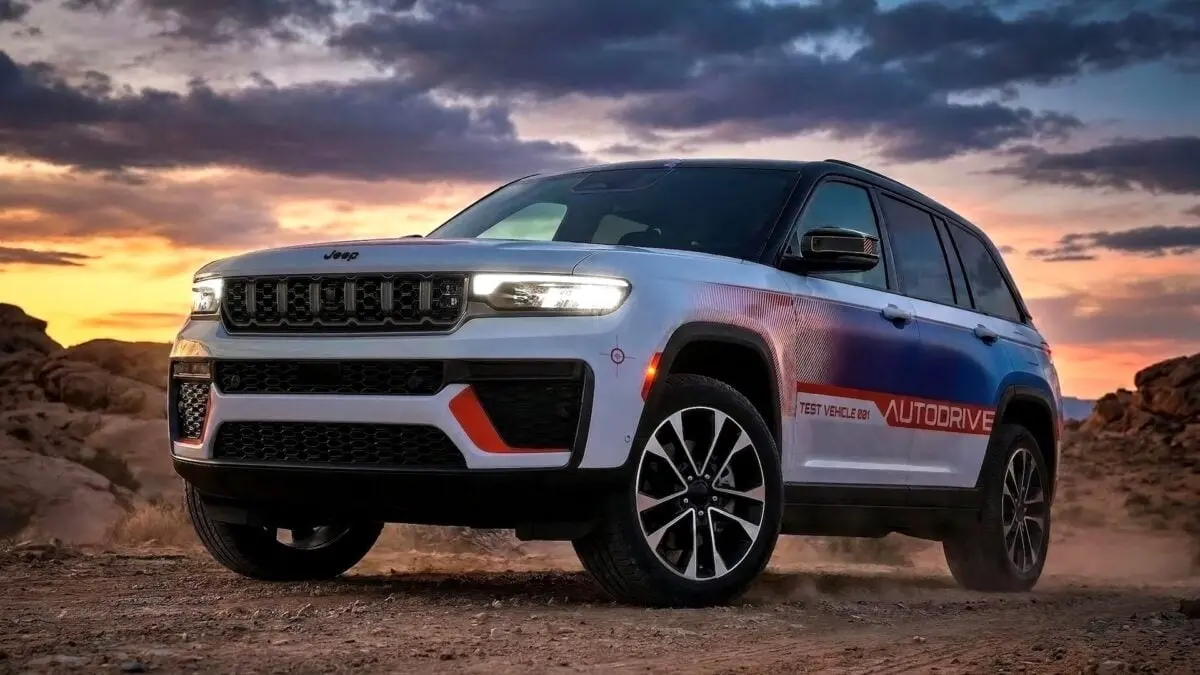
As robotaxi services steadily pop up in cities around the world, self-driving technology in commercial passenger cars has been slow to catch up. Stellantis, the parent company of Jeep, Ram, Dodge, Fiat, and several other car brands, is the latest automaker to announce plans to bring more advanced automated driving tech to its vehicles.
The Partnership
The company announced Thursday a new strategic technology partnership with U.K.-based startup Wayve. The partnership aims to integrate Wayve’s AI Driver system into Stellantis’ STLA AutoDrive platform. That could eventually equip some Stellantis vehicles with hands-free, supervised driving tech that works on both city streets and highways, similar to systems already available on Tesla and Rivian vehicles. Stellantis and Wayve are describing this first iteration as a Level 2++ system, meaning drivers would still need to pay attention to the road and supervise the vehicle as it drives.
The first vehicle integration is planned for North America in 2028. Stellantis says the platform can support more advanced automated driving features down the road as regulations and customer expectations evolve. “This agreement marks an important next step for Wayve and Stellantis in scaling our technology together,” said Alex Kendall, co-founder and CEO of Wayve, in a press release. “Our teams have already demonstrated how quickly the Wayve AI Driver can be integrated across Stellantis’ vehicle platforms, bringing up a prototype in less than 2 months.”
While there is no word yet on which specific brands or models would get the tech first, Wayve developed a prototype with Stellantis in just a few weeks on the company’s Jeep Cherokee platform. This rapid prototyping capability is a testament to the flexibility of Wayve’s software stack.
Wayve's Technology
Founded in 2017, the London startup makes autonomous-driving software that learns from real-world traffic using cameras and machine learning. This theoretically eliminates the need for detailed maps that its competitors rely on. Instead of building its own driverless cars, Wayve is focused on the software, which it says is vehicle-agnostic, meaning it can be adapted to work on everything from passenger cars to delivery vans. The company's approach is based on end-to-end deep learning, where the system learns driving behavior from vast amounts of data rather than being programmed with explicit rules. This methodology is similar to what Tesla pursues with its Full Self-Driving system, but Wayve emphasizes that its solution is designed to be hardware-agnostic and easily integrated by multiple automakers.
Wayve's AI Driver uses a combination of cameras, radar, and potentially other sensors, but the company has publicly stated its preference for a camera-centric approach. This reduces costs and simplifies integration compared to systems that rely on expensive lidar arrays. The software is trained on millions of miles of real-world driving data collected from partner fleets and public roads in the UK and other regions. This data-driven training allows the system to handle complex scenarios like roundabouts, pedestrian crossings, and diverse weather conditions.
Industry Context and Expansion
The buzzy startup announced earlier this year that it had closed a $1.2 billion Series D investment round with a range of investors, including SoftBank, Microsoft, Nvidia, and Uber. And just last month, Advanced Micro Devices, Arm, and Qualcomm Ventures announced a separate $60 million investment in the company. These investments highlight the growing confidence in Wayve's technology and business model. Uber’s investment will specifically support Wayve-powered robotaxis on the Uber platform. The companies intend to launch their first service in London in 2026, with plans to expand across multiple markets.
Nissan has also signed on to use Wayve’s technology. In December, the automaker announced that it would integrate Wayve’s tech into a broad range of its cars starting in 2027. This multi-automaker strategy positions Wayve as a potential dominant player in the market for autonomous driving software, similar to how mobile operating systems work across different hardware manufacturers.
For Stellantis, this partnership is part of a broader push towards electrification and digitalization. The company has committed to spending over €30 billion on electrification and software through 2025. The STLA AutoDrive platform is a key component of this strategy, and integrating Wayve's AI Driver could provide a competitive edge against rivals like General Motors (with its Super Cruise system) and Ford (BlueCruise). Currently, many automakers offer Level 2 systems that work on highways but struggle with city streets. Wayve's system claims to handle both, which would give Stellantis a more versatile offering.
The autonomous driving landscape is becoming increasingly crowded, with players like Waymo, Cruise, and Mobileye (owned by Intel) all vying for market share. However, most of these companies focus on robotaxi fleets or require extensive map data. Wayve's approach could be more scalable for passenger vehicles because it reduces the need for high-definition mapping, which is expensive and time-consuming to maintain. This is especially important for Stellantis, which sells vehicles globally in diverse regions with varying road conditions.
Another advantage of the partnership is the potential for over-the-air updates. Wayve's software can continuously improve through data collected from the fleet, allowing Stellantis to offer new features and refinements to customers without requiring dealership visits. This over-the-air update capability is already a hallmark of Tesla's approach and is becoming expected by consumers.
Safety is, of course, a paramount concern. Level 2++ systems still require driver supervision, but they reduce the cognitive load on long journeys or in stop-and-go traffic. Wayve and Stellantis are emphasizing that the technology is designed to augment the driver, not replace them. Regulatory frameworks in North America are still evolving, but the National Highway Traffic Safety Administration (NHTSA) has been increasing its oversight of automated driving systems. The 2028 timeline gives both companies time to ensure compliance and build public trust.
Looking at the broader automotive industry, the trend is clear: automakers are increasingly sourcing technology from startups rather than developing everything in-house. This speeds up innovation and reduces risk. Wayve, with its strong backing from tech giants and strategic investors, appears well-positioned to become a leading supplier of autonomous driving software. The Stellantis partnership is a significant validation of its technology.
In summary, the collaboration between Stellantis and Wayve represents a major step toward bringing advanced self-driving capabilities to mainstream SUV and truck brands like Jeep, Ram, and Dodge. The first wave of vehicles equipped with this technology is expected to arrive in 2028, offering a hands-free experience on both highways and city streets. As the system evolves, it could pave the way for higher levels of automation, changing how millions of people interact with their vehicles every day.
Source: Gizmodo News