

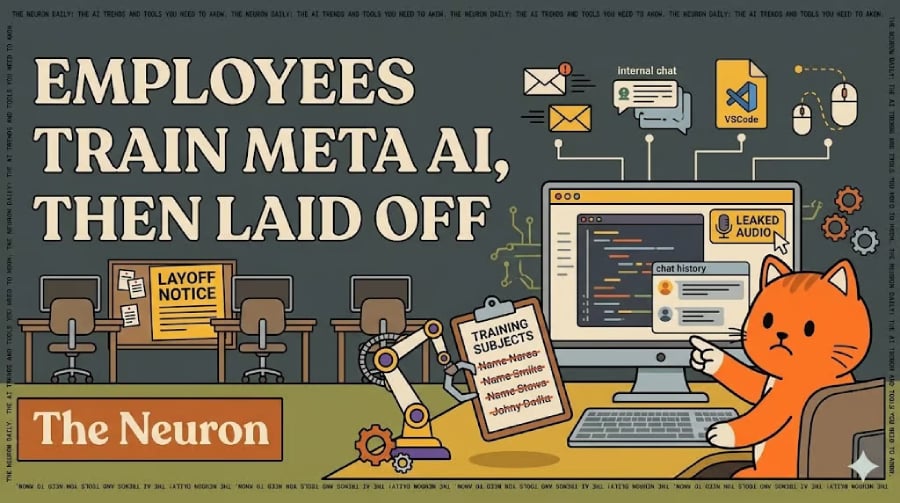
In a startling revelation that has rippled through the tech world, a leaked audio recording has uncovered the rationale behind Meta's decision to intensively monitor employee activity before carrying out its mass layoffs in 2022 and 2023. The recording, reportedly from an internal meeting with a senior Meta executive, details how the company used productivity metrics, badge swipes, and even network activity to gauge employee engagement and identify potential redundancies.
The leak provides a rare glimpse into the corporate decision-making process that led to the elimination of more than 20,000 positions over two major rounds. According to the audio, Meta's leadership believed that traditional performance reviews were insufficient to determine which employees were truly essential. Instead, they turned to data-driven tracking tools that could measure everything from time spent in the office to collaboration patterns on internal platforms.
This approach is not entirely new in Silicon Valley, but the scale and intent at Meta have drawn particular scrutiny. The company, which had aggressively hired during the pandemic boom, found itself overstaffed as advertising revenue slowed and competition from TikTok intensified. CEO Mark Zuckerberg declared 2023 the "Year of Efficiency," promising to flatten the organization and cut middle management.
The leaked audio suggests that the tracking was designed to answer two key questions: who was working on high-priority projects and who was simply "coasting." The executive in the recording is heard saying that "we need to see who's really pushing the boundaries versus who's just filling a seat." The company collected data on how often employees accessed internal tools, whether they attended meetings, and even how quickly they responded to messages.
How the Tracking Worked
According to multiple reports, Meta employed a combination of existing internal analytics and newly deployed monitoring software. The company has long used tools like Workplace, its internal social network, and various project management systems. During the pre-layoff period, these tools were reportedly configured to provide managers with dashboards showing individual activity levels.
Some employees later told media outlets that they received warnings if their badge swipes were too infrequent or if they had not logged into their work accounts for a certain number of days. While Meta framed this as a safety and security measure, the audio reveals that the data was also used to compile lists of low-engagement employees who were then flagged for potential layoff.
Tech workers have long debated the ethics of such monitoring. Critics argue that it creates a culture of fear and fails to account for the reality that knowledge work is often asynchronous and non-linear. A developer might spend hours thinking about a problem without touching a keyboard, yet the tracking systems would show them as inactive.
"These metrics are at best incomplete and at worst punitive," said one former Meta engineer who spoke anonymously. "The company was looking for any reason to trim headcount, and they used data points that were never designed for that purpose."
The Layoffs: A Record in Tech History
Meta's layoffs were among the largest in corporate history. In November 2022, the company cut 11,000 jobs, representing about 13% of its workforce. A second round in March 2023 eliminated an additional 10,000 positions. The cuts affected teams across the board, from recruiting and engineering to product management and content moderation.
The leaked audio appears to have been recorded shortly before the first wave of layoffs. The executive can be heard explaining that "the tracking helps us understand which teams are truly critical. We can't afford to keep everyone, and we need to make decisions based on data, not sentiment." The rationale echoes what many large companies have argued: that during periods of rapid hiring, inefficiencies creep in, and layoffs are a way to restore discipline.
However, the tracking has raised legal and ethical questions. Several labor advocates have pointed out that employee monitoring must comply with privacy laws, especially in jurisdictions like California and the European Union. While Meta likely had the legal right to monitor its own systems, the secretive nature of the program and the way the data was used could invite lawsuits.
In fact, a class action suit was filed in early 2023 by former Meta employees who claimed that the company misled them about the criteria for layoffs. The suit alleges that Meta's internal tracking data was used to discriminate against certain groups, including older workers and those on family leave. The leaked audio could become a key piece of evidence if the case proceeds.
Broader Context of Employee Surveillance
Meta is far from alone in its use of employee monitoring. A 2022 study by ExpressVPN found that 60% of large U.S. companies now use some form of employee surveillance software, up from 30% before the pandemic. Tools like Time Doctor, Hubstaff, and Teramind track keystrokes, mouse movements, and app usage. Meanwhile, platforms like Microsoft 365 and Slack offer employers dashboards that show how often employees are active.
But the Meta leak highlights a specific concern: surveillance that precedes mass layoffs. When employees know they are being watched and that the data could determine their job security, it can degrade trust and morale. Some economists argue that such monitoring is counterproductive because it encourages presenteeism—showing up and appearing busy—rather than actual productivity.
Another dimension is the psychological toll. Several former Meta staffers have described the months before the layoffs as a "paranoid environment" where people felt compelled to be seen online at all hours. "I would leave my Slack open on my phone just to show that I was responding after work," one recalled. "But that kind of behavior is not sustainable."
What the Leak Reveals About Meta's Culture
Beyond the operational details, the leaked audio offers a window into Meta's internal culture during a period of crisis. The company, which had long prided itself on a "move fast and break things" ethos, was suddenly forced to reckon with the consequences of overexpansion. The audio suggests that leadership was desperate to regain control and saw data as the most objective way to do so.
Yet objectivity is an illusion when the data itself is shaped by biases. For instance, employees on parental leave or medical leave would naturally show lower activity levels, but the tracking system did not automatically adjust for such circumstances. Several reports indicate that workers in these categories were disproportionately cut.
The audio also hints at a tension between the desire for efficiency and the practical realities of managing a global workforce. The executive in the recording acknowledges that "some of our best people are not the ones who are always online," but then pivots to say that "we still need some way to differentiate." This ambivalence suggests that even Meta's leadership was not entirely comfortable with the tracking program.
Industry observers have noted that the leak could have long-term consequences for Meta's reputation, especially in the talent market. Engineers and other professionals may be less willing to join a company that has a history of such surveillance. Indeed, some tech recruiting experts have reported that candidates are now asking more questions about monitoring practices during interviews.
The leaked audio is likely to fuel ongoing debates about the balance between corporate oversight and employee privacy. As AI and analytics tools become more advanced, companies will have even greater ability to track every aspect of work. The Meta case serves as a cautionary tale about how those tools can be used in ways that undermine trust.
For now, Meta has not publicly commented on the authenticity of the leaked audio. But the contents align with other known details about the company's internal processes. As the tech industry continues to evolve, the question remains: how much monitoring is acceptable, and who gets to decide?
Source: eWEEK News