

As 3D printing becomes increasingly accessible and printers continue to drop in price, researchers in academia are finding a wealth of new applications. They are also revisiting older concepts that were once considered impractical, to see if modern additive manufacturing can bring them to life. This is precisely what a team at MIT's Computer Science and Artificial Intelligence Laboratory (CSAIL) did. They built a working three-sided zipper based on a design proposed by a professor nearly 40 years ago.
The idea originated in 1985 with William Freeman, a professor who envisioned a zipper with three sides instead of the traditional two. His concept was based on the structural rigidity of a triangle. By zipping three belts together, a flexible material could become a rigid triangular truss, and then be unzipped to return to its soft, packable state. Freeman entered the design in a competition but did not win. Nevertheless, he patented the idea. For decades, the concept remained dormant because manufacturing the custom teeth and sliders was too expensive and complex.
Fast forward to the 2020s: 3D printing technology has matured to the point where custom plastic parts can be produced rapidly and at low cost. The MIT CSAIL team, led by researchers including Jiaji Li, decided to revisit Freeman's design. Using 3D printing, they could experiment with different tooth geometries, materials, and slider mechanisms. The result is a series of working prototypes that demonstrate the practical benefits of the three-sided zipper.
How the Three-Sided Zipper Works
The zipper consists of three separate tracks, each lined with interlocking teeth. A special slider pulls the three tracks together, forming a triangle in cross-section. When zipped, the three sides create a rigid beam-like structure. Unzipping releases the tracks, allowing the material to collapse into a flat, flexible sheet. This ability to switch between rigid and soft states is what makes the design so versatile.
The team's first major prototype was a collapsible tent. Traditional tents rely on separate poles that must be threaded through sleeves, a process that can take several minutes. The 3D-printed zipper tent uses three flexible fabric panels that zip together along their edges. The zipping action simultaneously erects the tent and creates a rigid triangular frame. In tests, the tent could be assembled in just 1 minute and 20 seconds, compared to 6 minutes for a conventional tent. The researchers note that larger versions could be deployed for emergency shelters or disaster relief operations, where speed is critical.
Versatility Across Applications
Beyond camping, the zipper has potential in robotics. The team built a small quadruped robot whose legs incorporate zipper segments. A motorized slider can zip or unzip parts of each leg, effectively changing the leg's length. This allows the robot to raise its feet to clear obstacles like rocks, then lower them for stability on flat terrain. The adjustment is quicker than traditional telescoping mechanisms.
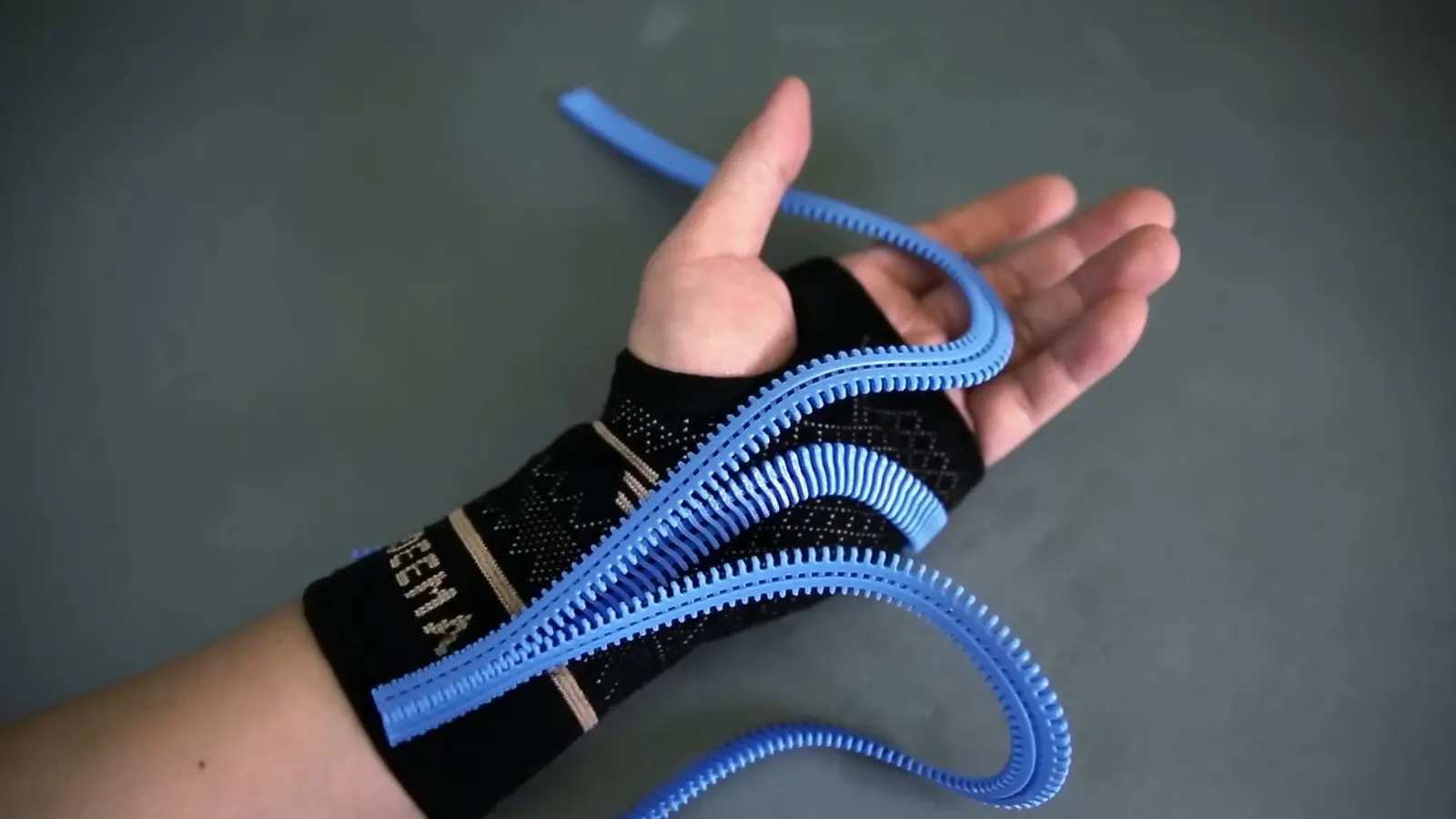
Another prototype is a wrist cast. The cast is a flexible sleeve with zipper tracks embedded along the sides. When zipped, the sleeve becomes a rigid protective shell suitable for impact protection. When the wearer needs to move or wash, the cast can be quickly unzipped. This design offers a comfortable, adjustable alternative to conventional plaster or fiberglass casts.
The team also created an art installation: a twisting vine that moves as a zipper is opened and closed. Though less practical, it illustrates the aesthetic possibilities of the mechanism.
Material Choice and Durability
For the zippers to be truly useful, they must withstand repeated use. The researchers tested two common 3D printing filaments: PLA (polylactic acid) and TPU (thermoplastic polyurethane). PLA zippers proved more durable, lasting through an average of 18,000 zip-unzip cycles before failure. TPU zippers, while less durable, offered greater flexibility, which could be beneficial for applications needing some give. The team noted that consumer-grade printers and filaments were sufficient for the prototypes, making the technology accessible to a wide audience.
The choice of material also affected the zipper's feel and noise. PLA zippers clicked firmly into place, while TPU zippers were quieter and softer. For a camping tent, durability matters most; for a wearable, flexibility might be preferred.
Historical Context and Future Potential
The zipper itself is a relatively modern invention. The first functional zipper was patented in 1893 by Whitcomb Judson, and it took decades for the design to be refined into the reliable fastener we use today. The three-sided zipper is a natural extension of the same principle, but it required the precision of 3D printing to become practical. Freeman's original patent might have been ahead of its time, but now the technology has caught up.
The MIT team sees many more possibilities. They suggest using a zipper on a spacecraft to grab rock samples—by zipping around a boulder, the zipper could secure it without needing complex grippers. Other flexible wearables, such as knee braces or support belts, could also benefit from the reversible rigidity. The researchers are continuing to explore different tooth shapes, materials, and slider designs to optimize performance for specific tasks.
What makes this story compelling is how a long-dormant concept has been revived by a new technology. The three-sided zipper is not just a clever gadget; it could transform how we think about portable structures, adaptive robotics, and medical devices. As 3D printing becomes even more widespread, we can expect more old ideas to be dusted off and turned into reality. The zipper's journey from a 1985 sketch to a working prototype in the 2020s is a testament to the power of persistence and technological progress.
Source: SlashGear News