

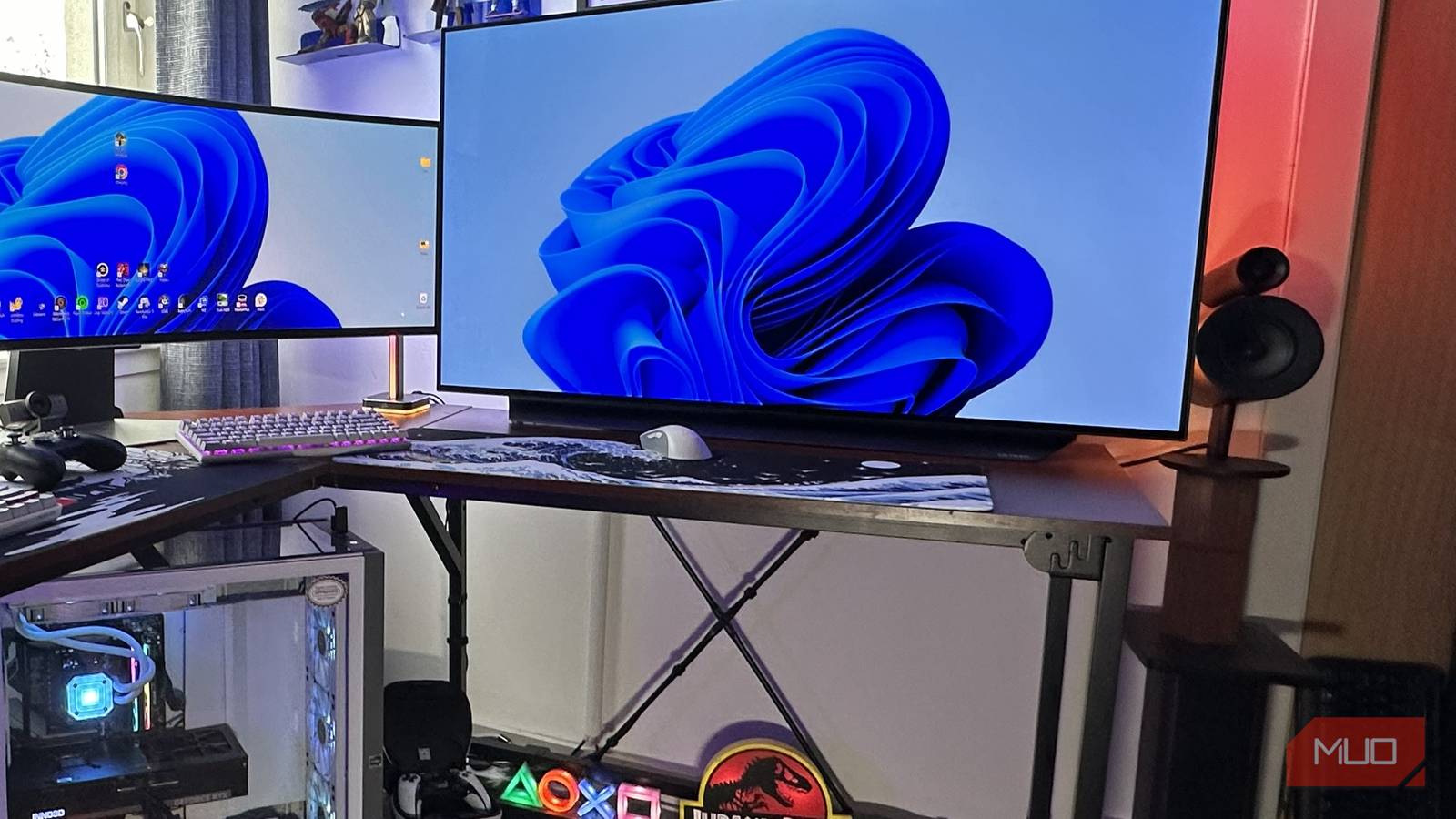
Untidy workspaces really grind my gears. I’m guessing that’s a result of working in a spectacularly cluttered office for the best part of a decade, many moons ago. This was a place where great bunches of knotted-up cables snaked all over desks, and where the walls were composed of 90% teabag stains. Ick. It’s no wonder I’m now obsessed with hiding my cables out of sight.
Good cable management takes some elbow grease, but happily, it’s also pretty dang cheap if you decide your home office or entertainment area needs a good dose of decluttering. With a few ultra-affordable accessories you can easily pick up online or from your local office supply store, you can have your workspace looking spic and span in short order. Let me give you some cable management tips that have helped make my office less of an iris-offending mess.
Prepping to declutter your setup
The early steps of tidying your tech
So you’ve finally decided to spruce up your home office or entertainment cabinet. Kudos! Here are five cable management tricks you should follow. Knowing you have a problem is the first step to recovery. As much as I take pride in both my bedroom and lounge tech setups being (mostly) free from visible wires, I’ve occasionally let my apartment get into a bit of a state because I couldn’t be bothered to organize my cables properly. As you can painfully see above. Do yourself a favor and don’t give in to your unkempt side. Decluttering wires and other accessories that might be clogging up your floor really isn’t that difficult. And if you know which pieces of kit you need to pick up, removing cables from your eyeline will cost you barely anything.
Your first step before you untangle all of those wires that might be hanging around your monitor or TV is to unplug everything. I don’t care how many HDMI, DisplayPort, or power cables you’re dealing with; get them unplugged. From there, you need to untangle the nest of unruly wires so that they’re all separated. I know my Samsung Odyssey OLED G9 needed serious cable management when I was setting it up with my current PC. This is probably the most painful part of the process, and it’s akin to solving a Rubik's Cube that keeps resetting itself every 99 seconds. Persevere, though, and you’re well on your way to willing a tidier desk/TV area into existence.
Once you’ve untangled your wires, give your desk or TV cabinet a quick wipe-down before proceeding. If your setup is anything like mine before I dedicated myself to getting my cables under control, your work or entertainment space might well be encrusted in dust. A clean surface ensures that the adhesive strips on cable management accessories will stick properly. Also, check the condition of your cables—any frayed or damaged wires should be replaced for safety reasons. This is also a good opportunity to label each cable with small tags or colored tape so you can easily identify them in the future, saving time during future rearrangements.
Handy gear for hiding those cables
What you’ll need to tidy those leads away
I’ve bought a lot of cable-uncluttering accessories over the years. I’d wager the total sum of buying a lot of little things that have made wire management relatively easy for me is way less than $100. So if you want to rid your desk setup of unruly crumples of wires, it’s not going to hit your wallet all that hard. My go-to pieces of kit for tidy cable management? A mixture of cable trunking, cable management boxes where you can stuff all of your wires out of view, and cable ties. For the latter, it’s better to go with Velcro options over traditional cable ties, as you’ll be able to reuse them next time you reshuffle your setup.
Cable trunking, also known as raceways, are plastic channels that attach to walls or the underside of desks. They come in various sizes and colors, and most have removable covers so you can add or remove cables without trouble. The self-adhesive backing makes installation quick, but be cautious if you’re renting—peeling off the trunking could damage paint or wallpaper. For renters, magnetic cable clips or adhesive cable clips that are less permanent are better options. Cable management boxes are essentially plastic or cloth boxes with slots at the top and bottom to feed cables through. You place your power strip or surge protector inside the box, then close the lid, hiding the mess of plugs and adapters. These boxes also protect cables from dust and pets.
Beyond trunking and boxes, I also recommend using under-desk cable trays. These metal or plastic trays screw into the underside of your desk, providing a flat surface to coil excess cable length. They are especially useful if you have multiple devices like monitors, speakers, and a PC tower. For floor-level cables, consider using cable sleeves—spiral wrap or braided sleeves that bundle multiple cables into one neat tube. This is great for the cables running from your desk to the wall outlet. Lastly, don’t forget about small clips and adhesive cable tie mounts that keep individual wires in place along the edge of your desk. These prevent cables from slipping down and becoming tangled again.
When buying these accessories, measure the length and thickness of your cable runs. Cheaper products may have weaker adhesive, so invest in higher-quality ones if you can. Also, think about aesthetics: white trunking blends into white walls, while black or gray options suit darker furniture. If you have a lot of cables, color-coordinate them with the trunking to make the entire setup look cohesive. Some people even paint the trunking to match the wall—just make sure the paint is compatible with the plastic.
The benefits of tidy tech
Decluttering my setups has made me enjoy my technology a lot more
Since I tidied up both my office space and my TV area, I can happily report that I’m enjoying working and gaming in my apartment without the constant guilt of being a mucky pup. When my dual setups were a bit of a shambles, a tiny voice in my head would perpetually nag me. “Clean up your tech mess, you savage slob!” Admittedly, I might have cleaned up the language from that internal monologue a smidge. Oh, and don’t ignore cleaning your PC while you’re at it.
Seriously, though, I find it easier to concentrate when there are few visible distractions on my desk… or on the floor under it. Similarly, I can slip into my favorite movies or some of the best PC games with a weight lifted off my shoulders when untidy clusters of cables aren't trying to sneak into the corner of my eye. On the work front in particular, the fact that I’m no longer constantly needling myself to see my HDMI and DisplayPort cables hanging behind my super ultrawide monitor has made work easier, and has at least given me one less excuse for being distracted when writing.
Beyond mental clarity, a decluttered setup has practical advantages. Clean air flows more freely around your computer tower, reducing dust buildup inside the case. Fewer cables on the floor also means less tripping hazard, especially if you have pets or children. Furthermore, when cables are organized, you can quickly identify which plug belongs to which device—no more feeling behind your desk like a contortionist trying to unplug something. If you ever need to move your setup, you can simply unplug the neatly bound cables and reconnect them without confusion.
Another benefit is the increased lifespan of cables. When cables are coiled loosely and not under stress from tangles or heavy objects, they are less likely to suffer from kinks or internal breaks. This is especially important for high-speed data cables like DisplayPort 1.4 or USB-C, where signal degradation can occur if the cable is bent sharply. By using cable management, you protect your investment in quality peripherals.
Tighten your tech with a decent declutter
With an assortment of affordable cable-management accessories, you can easily breathe new life into your office or entertainment space. Looking back, I regret those years when I was far too content working in spaces where wires dominated my viewpoint. Now that I’ve finally decluttered at long last, I can work and chill out without persistent guilt. If you feel like your tech setup is getting a little messy, do some decluttering. I guarantee you’ll feel better afterward.
To get started, set aside an afternoon—it may take longer than expected if you have a complex setup. Gather your supplies: cable trunking, Velcro ties, a management box, cleaning wipes, and possibly a label maker. Unplug everything, dust off all surfaces, and then plan where each cable will go before sticking anything down. Remember to leave some slack at both ends so you can still move your monitors or PC slightly if needed. Once everything is in place, step back and admire your handiwork. The difference is striking—not just visually, but also in how it feels to sit at a clean desk.
If you’re working with a shared space, like a living room entertainment center, involve other household members in the planning. They might have ideas for hiding cables behind furniture or using decorative covers that blend with the decor. Some people even use plants or books to mask power strips. The key is to be creative and find solutions that work for your specific layout.
Finally, don’t think of cable management as a one-time task. As you add new devices or rearrange your room, you’ll need to adjust. The beauty of using reusable Velcro ties and adjustable trunking is that you can easily make changes without buying new supplies. Make it a habit to check your cable setup every few months. Over time, it becomes second nature, and you’ll wonder how you ever tolerated a tangled mess.
Source: MakeUseOf News